Eigenlayer connects restaked assets to service security and additional slashing risk
Eigenlayer lets Ethereum stakers reuse their stake to secure additional services, exposing committed assets to extra slashing penalties. Participation covers native ETH, liquid staking tokens, EIGEN, and other supported ERC-20 assets. Operators run the services and commit delegated capital. Rewards depend on service participation, while losses follow the applicable allocation and slashing rules.
Jump to a section
Deposits establish a restaked balance; delegation assigns it to an operator. Allocation gives a service specific collateral it can penalize. Withdrawal delays and any liquid restaking wrapper then affect how quickly the owner can regain access to funds.
An operator's new service allocations can expose existing delegated stake to additional slashing risk after the applicable delays expire.
Restaked Capital and AVS Commitments
Restaked capital gives service developers access to collateral and operators without requiring a separate security network for every application. These applications are Actively Validated Services, or AVSs. Their operators perform work outside Ethereum's execution environment, while contracts handle commitments, rewards, and penalties. Services can cover data availability, oracle responses, or cross-chain verification. Each developer still defines the service's tasks and enforcement design. A large protocol-wide deposit balance therefore says little about the collateral actually committed to a particular service.
Multichain verification also lets services verify operator commitments on supported destination chains while the backing stake remains on Ethereum. Deployment support for verification does not automatically create a restaking deposit interface on every destination.
Native ETH, Token Strategies, and EIGEN
Native restaking connects an Ethereum validator's withdrawal credentials to an EigenPod, a smart contract associated with its owner. This route requires Ethereum validator infrastructure and compatible withdrawal credentials. A validator whose execution withdrawal address already points elsewhere cannot redirect that address to a pod. Withdrawal credential proofs establish the validator's relationship with the pod, and checkpoint proofs update restaking accounting as balances change.
Liquid staking token holders can deposit supported tokens into token strategies without operating their own Ethereum validator. An LST represents a claim on underlying staked ETH and staking yield. Restaking adds service commitments to that exposure; it preserves the dependencies on the original staking provider and its redemption mechanism.
Permissionless token strategies extend participation to ERC-20 assets an AVS accepts as collateral. Creating a strategy and accepting it into a service are separate requirements. A token's presence in the broader protocol does not mean every operator set accepts it or pays rewards for it.
EIGEN is another staking asset, with a design addressing intersubjective faults: wrongdoing observers can broadly agree occurred without a straightforward onchain proof. Its role differs from ETH collateral. The service's implementation determines which security commitments apply.
Delegation and Unique Stake Allocations
Delegation assigns an address's available restaked balance to one operator at a time. Additional deposits follow an existing delegation automatically. The operator runs AVS software and chooses its service allocations. Selecting an operator therefore affects which services the capital supports and which service conditions can expose it to penalties.
Unique Stake accounts for portions of delegated collateral allocated to specific operator sets. A Unique Stake allocation is slashable exclusively by the AVS which created its operator set. This separates service allocations and bounds the collateral each set can penalize. It does not require an operator to commit its entire delegation to one service.
Operators can change their allocations after delegation. Existing deposits can consequently acquire different service exposure, including participation in redistributable sets, subject to the protocol's allocation delays.
Service Rewards and Participation Costs
AVS rewards compensate qualifying stakers and operators under the service's chosen distribution method. The rewards framework supports performance-based payments and distributions weighted by total delegated stake or allocated Unique Stake. Operator reward splits can vary by AVS or operator set, reducing the portion reaching delegated stakers. Eligible reward submissions can also incur a protocol fee when the submitter opts in. Ethereum validator earnings and an LST's underlying staking yield remain separate from these service payments. Comparing returns therefore requires identifying the reward asset, eligibility period, applicable split, and funding source.
EIGEN emissions to the ETH quorum, covering ETH and ETH-denominated LST stake, ended on July 30, 2026. Earlier ETH-quorum EIGEN rewards remain claimable, and EIGEN-quorum rewards are unaffected. AVS-funded rewards remain a separate category, governed by each service's submissions and participation rules.
Ethereum transactions add gas costs for approvals, deposits, delegation changes, reward claims, and withdrawals when those operations require transactions. Native restaking also incurs proof-submission costs. A displayed annualized rate cannot establish future rewards or the net return after these expenses.
Does Restaking Give Every AVS Ethereum's Full Security?
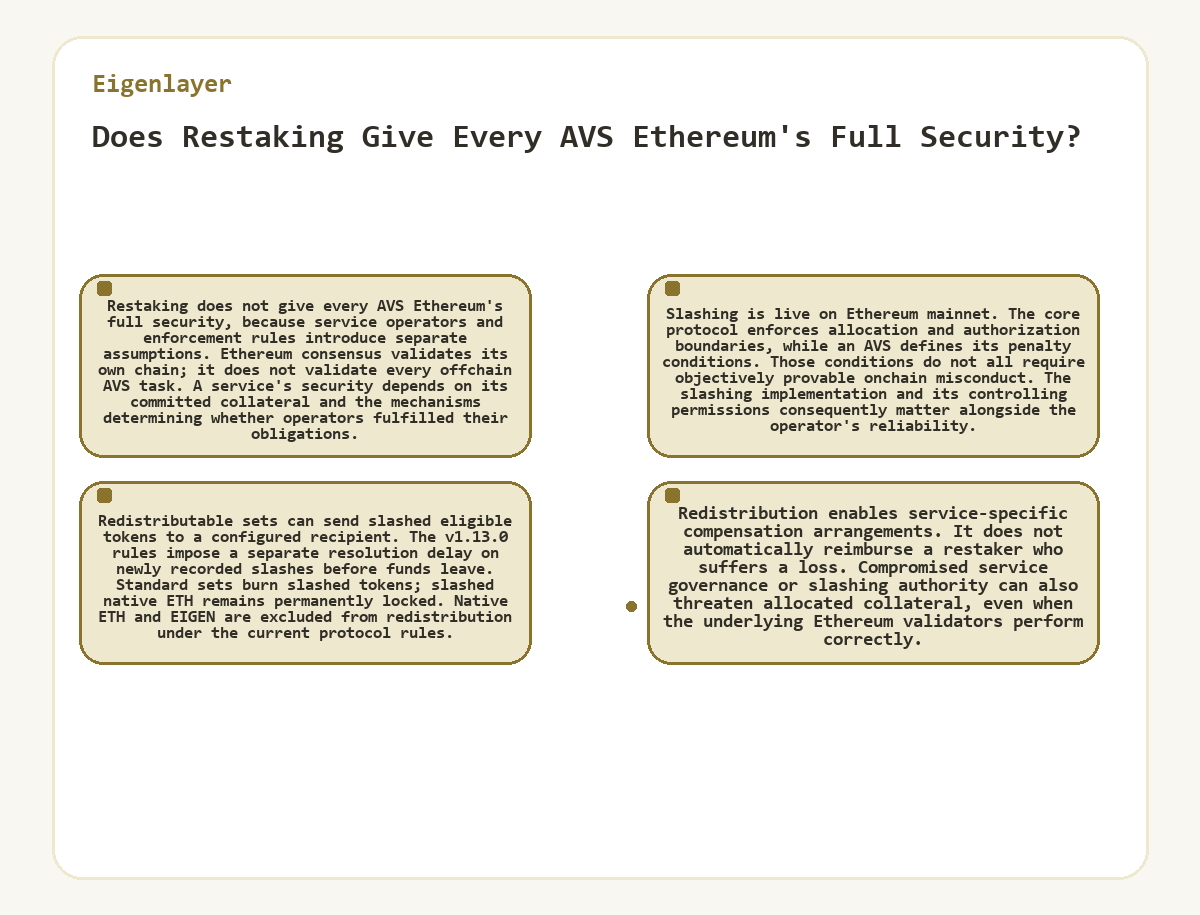
Restaking does not give every AVS Ethereum's full security, because service operators and enforcement rules introduce separate assumptions. Ethereum consensus validates its own chain; it does not validate every offchain AVS task. A service's security depends on its committed collateral and the mechanisms determining whether operators fulfilled their obligations.
Slashing is live on Ethereum mainnet. The core protocol enforces allocation and authorization boundaries, while an AVS defines its penalty conditions. Those conditions do not all require objectively provable onchain misconduct. The slashing implementation and its controlling permissions consequently matter alongside the operator's reliability.
Redistributable sets can send slashed eligible tokens to a configured recipient. The v1.13.0 rules impose a separate resolution delay on newly recorded slashes before funds leave. Standard sets burn slashed tokens; slashed native ETH remains permanently locked. Native ETH and EIGEN are excluded from redistribution under the current protocol rules.
Redistribution enables service-specific compensation arrangements. It does not automatically reimburse a restaker who suffers a loss. Compromised service governance or slashing authority can also threaten allocated collateral, even when the underlying Ethereum validators perform correctly.
EigenDA Within EigenCloud
EigenDA uses Eigenlayer-backed operators to store and serve encoded data for applications such as rollups. Data availability lets applications obtain their published data; it is a separate function from transaction execution and execution verification. EigenCloud, introduced on June 17, 2025, groups this infrastructure into a broader developer platform built atop the restaking protocol. EigenCompute adds containerized compute within that platform. Eigenlayer remains the stake and economic commitment layer, while these products supply distinct services with their own operating requirements.
Does a Liquid Restaking Token Remove Withdrawal Delays?
A liquid restaking token leaves the underlying withdrawal delay in place, although selling the token can provide an earlier market exit. An external wrapper issues this receipt for its restaking position and adds its own contracts, allocation choices, and redemption terms.
In this hypothetical comparison, a holder needs funds before a protocol withdrawal becomes available. Assume the alternative wrapper token has an accessible trading market. A direct restaking position must follow the applicable withdrawal conditions. The receipt holder can instead sell the wrapper token; a completed sale delivers market proceeds without releasing the underlying collateral early.
The sale meets the holder's timing requirement only while buyers and sufficient liquidity exist. Its price can fall below the underlying claim's value. Wrapper redemption and a market sale therefore produce different exit conditions, even when both relate to the same restaked collateral.
Withdrawal Queues and Fixed-Term Vaults
Ordinary restaking withdrawals enter a queue before the owner can complete them. Eigenlayer's v1.13.0 Ethereum mainnet configuration sets the minimum withdrawal delay to 100 800 blocks. At a 12-second block interval, that corresponds to approximately 14 days. Queue entry alone does not return assets to the wallet, and queued shares remain subject to applicable slashing. Penalties can reduce the amount available when the withdrawal becomes completable.
Native ETH access also depends on funds reaching the EigenPod and checkpoint accounting reflecting them. Withdrawing funds already available in the pod differs from withdrawing capital still held by a validator. Validator exits introduce Ethereum's own queue and withdrawal processing when an exit is necessary.
Duration Vaults provide a separate participation path with a fixed commitment period. Stakers must delegate to the vault before depositing. The vault's administrator then locks the deposited stake and allocates it to a specific operator set. These vaults support eligible ETH LSTs and other ERC-20 tokens, while excluding native ETH, EIGEN, and bEIGEN. The lock blocks new withdrawal queuing; withdrawals queued before locking can still complete. Anyone can open the withdrawal phase after the term expires, while the configured arbitrator can open it earlier. Stakers must still queue withdrawals and wait the standard delay before completing them. Withdrawals reflect any applicable slashing. Rewards require separate claims, which the vault's lock does not itself block. The fixed duration does not guarantee preservation of the original deposit.
A displayed balance can remain unavailable for spending until the applicable queue or vault conditions allow withdrawal.
Helpful answers about Eigenlayer
Is EIGEN a Receipt for ETH Deposited in Eigenlayer?
EIGEN is a separate token, not a receipt representing deposited ETH. Native restaking uses EigenPod and protocol accounting to track an ETH position. Acquiring EIGEN therefore does not create ownership of someone else's restaked ETH or automatically earn service rewards.
Can an Operator Transfer My Delegated Tokens to Its Own Wallet?
Delegation does not give an operator direct access to transfer your deposited tokens. It gives the operator authority to commit their value to service security. Those commitments can make collateral slashable, so the absence of direct withdrawal authority does not eliminate loss exposure.
Are AVS Rewards Always Paid in the Asset I Deposited?
An AVS can distribute a different ERC-20 reward token from the asset you deposited. The service chooses its reward assets through its submissions. Earnings therefore need separate interpretation from deposit balances, including the reward token's market value and available liquidity.
When Do Accrued Restaking Rewards Become Claimable?
Rewards become claimable when a valid distribution root covering them reaches its activation time and claims remain enabled. A root summarizes calculated earnings, and a claim uses a proof against it. Accrued earnings can therefore appear before an actionable claim exists.
Must I Claim Rewards After Every Distribution?
You do not need to claim against every reward distribution. The rewards accounting is cumulative, so a later active root can include earlier unclaimed earnings. The claim pays the difference between cumulative earnings and amounts already claimed for each included token.
Do Queued Withdrawals Continue Earning AVS Rewards?
The stake queued for withdrawal stops accumulating AVS rewards, including when undelegation creates the queue. This rule concerns restaking reward eligibility. An active Ethereum validator can continue earning its separate consensus rewards until its validator status changes, even while a restaking withdrawal remains pending.
What Does Approving Token Spending Actually Authorize?
Token approval authorizes the specified spender to move the approved token within its allowance. Approval alone does not establish a completed restaking deposit or operator delegation. The spender address and permitted amount define the authority granted by that approval.
Who Owns an EigenPod After Deployment?
The address deploying an EigenPod becomes its owner, and that ownership cannot be transferred to another address. The owner controls the associated restaking and withdrawal operations. One owner address can deploy one EigenPod, although that pod can support multiple validators.