EigenLayer slashing limits on allocated restaked stake
EigenLayer slashing can remove up to the full allocation an operator commits to an operator set, with losses passed proportionally to exposed restakers in the affected asset strategy. There is no single loss percentage for every deposit. Your exposure depends on the effective allocation, the fraction the authorized slasher removes, and whether your shares remain slashable. Unallocated stake lies outside that set's AVS penalty reach, although underlying staking risks remain separate. Multiple operator sets can penalize their own allocations. Withdrawal requests also leave a period of continuing exposure, so a pending exit does not freeze the amount you will recover.
Table of contents
A withdrawal request leaves shares exposed to applicable operator slashing until the protocol's withdrawal window closes.
Service Commitments and Enforceable Penalties
Operator-set slashing backs service obligations with collateral, allowing an Autonomous Verifiable Service (AVS) to impose penalties when its enforcement rules permit a slash. Operators perform the service work and commit delegated stake. Restakers supply the assets behind those commitments, so an operator penalty can reduce their recoverable balances.
Different operator sets can carry different tasks and fault conditions within the same AVS. Incorrect computation and missed service obligations can support different penalty designs. A service decides which behavior warrants action and how severely to penalize it. Restaking rewards compensate participation; their payment does not establish a universal limit on principal losses.
How Much of My Restaked Balance Can Be Slashed?
A single operator-set penalty can consume its entire slashable allocation for an affected strategy, while the restaker's loss follows their proportional exposure to that allocation. A strategy is the protocol's accounting channel for a deposited asset. The slash fraction applies to the allocation within that channel, rather than automatically to every asset the restaker deposited.
The mechanism permits a penalty up to 100% of that set's allocation. A smaller allocation limits that set's direct reach into the strategy balance. Full allocation of a strategy to one slashable set can expose the entire associated withdrawable balance. Other sets can impose separate penalties against their own allocations.
Before rounding, the lost fraction of an active delegated position equals the allocation fraction multiplied by the penalty fraction. Both fractions refer to the state immediately before that slash. Historical penalties change the remaining accounting base, so applying a new percentage directly to the original deposit can misstate the loss.
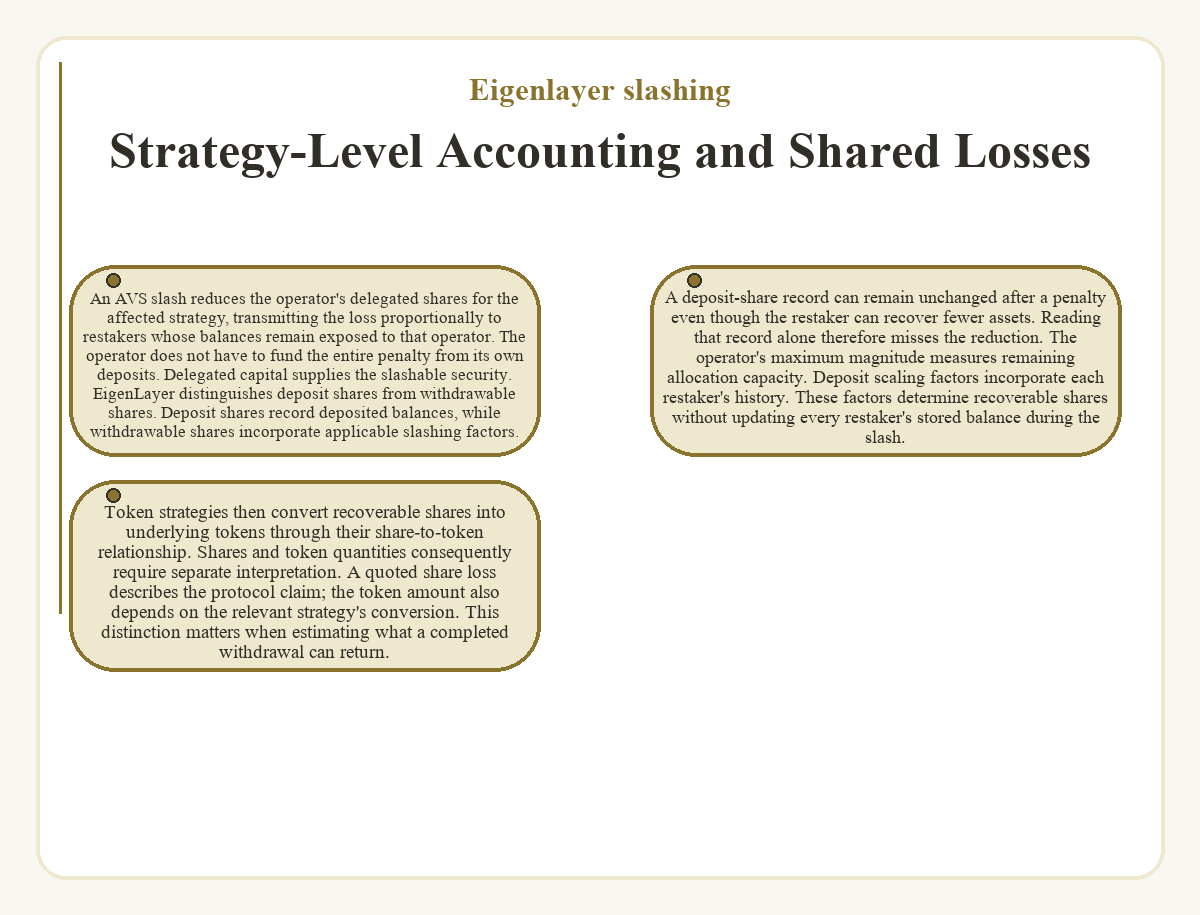
Strategy-Level Accounting and Shared Losses
An AVS slash reduces the operator's delegated shares for the affected strategy, transmitting the loss proportionally to restakers whose balances remain exposed to that operator. The operator does not have to fund the entire penalty from its own deposits. Delegated capital supplies the slashable security.
EigenLayer distinguishes deposit shares from withdrawable shares. Deposit shares record deposited balances, while withdrawable shares incorporate applicable slashing factors. A deposit-share record can remain unchanged after a penalty even though the restaker can recover fewer assets. Reading that record alone therefore misses the reduction.
The operator's maximum magnitude measures remaining allocation capacity. Deposit scaling factors incorporate each restaker's history. These factors determine recoverable shares without updating every restaker's stored balance during the slash.
Token strategies then convert recoverable shares into underlying tokens through their share-to-token relationship. Shares and token quantities consequently require separate interpretation. A quoted share loss describes the protocol claim; the token amount also depends on the relevant strategy's conversion. This distinction matters when estimating what a completed withdrawal can return.
Unique Stake and Multiple AVS Exposures
Unique stake separates slashable commitments between operator sets, preserving each set's allocated collateral against direct slashing by another set. An operator set can slash only the unique stake allocated to it for the affected strategy. The allocation boundary concerns enforceable collateral, not a guarantee about the likelihood of faults.
An operator cannot allocate more magnitude across sets than its remaining maximum magnitude for that strategy. A slash reduces the offending set's allocation and the operator's maximum magnitude together. Other allocations retain their magnitude, although their percentage of the remaining total can increase.
Several sets can still lose their own allocations during related failures. Shared operator software, infrastructure, or control can create overlapping operational risks even where collateral allocations remain separate. Splitting allocations therefore changes each set's loss boundary without establishing independence between all failure causes.
Fault Conditions and Slasher Authority
An operator set's authorized slasher executes its penalties, while the AVS supplies the rules for identifying faults and deciding when that authority should act. The core contracts enforce allocation and authorization boundaries. They do not independently determine whether every service-specific accusation proves misconduct.
A slashable allocation requires a relevant strategy, nonzero effective allocation, and an operator whose registration status still permits slashing. Registration normally supplies that eligibility. After deregistration, a trailing slashability window can preserve it temporarily.
AVSs can implement fraud proofs, governance decisions, or service-specific dispute procedures before execution. Their designs can include delays or veto arrangements upstream of the core slash call. Such protections belong to the particular service implementation; EigenLayer supplies no universal protocol-level veto for every AVS penalty.
Fault definitions deserve the same attention as allocation size. A small commitment to unclear or manipulable enforcement rules can lose its full allocation. Bugs or compromised slashing authority can also produce harmful penalties within the permitted boundary. A successful core transaction establishes execution, without independently proving the service's judgment was correct.
Native ETH and Underlying Staking Losses
Native ETH restaking combines AVS exposure with Ethereum validator balance accounting, so an AVS allocation ceiling does not cap every possible staking loss. EigenPod accounting includes a separate beacon-chain slashing factor. It can reflect validator balance decreases alongside the delegated operator's AVS penalties. Liquid staking tokens also retain their underlying staking dependencies. The operator-set limit describes only the additional AVS commitment.
Allocation Delays and Changing Exposure
An operator's allocation increase becomes effective under its configured allocation delay, making the effective amount and timing more informative than a submitted target allocation. That delay can differ between operators, including a zero setting. A notice about an increase therefore does not establish a universal period available to withdraw before exposure rises.
Changing the delay setting itself follows a separate configuration process. Under v1.13.0, the initial setting made during new operator registration takes effect immediately; later changes wait for the allocation configuration delay. Confusing the configuration delay with the delay on each allocation increase produces an incorrect exposure timeline.
Deallocation reduces an existing commitment after the protocol's deallocation delay when the allocation remains slashable. During the waiting period, the allocation can still suffer a penalty. Slashing also reduces the pending deallocation proportionally, leaving less magnitude to free when it takes effect. An allocation already outside slashing eligibility can deallocate immediately.
Commitment and Exit Choices
Allocation changes, operator deregistration, and restaker withdrawals affect different protocol records, so each choice leaves its own boundary on remaining exposure. The operator controls its allocations and service registrations. The restaker controls withdrawal of its own position. These actions do not substitute for one another.
| Commitment or Exit Choice | Remaining Slashing Exposure |
|---|---|
| Operator retains an active allocation | The set can penalize that allocation while the strategy and operator remain eligible. |
| Operator requests an allocation increase | Existing exposure continues; the added commitment follows the effective allocation delay. |
| Operator requests deallocation | Slashable collateral remains exposed until the reduction takes effect. |
| Operator deregisters from a set | Existing allocations can remain slashable through the trailing registration window. |
| Restaker queues a withdrawal | The queued shares retain applicable operator exposure through the withdrawal window. |
Operator deregistration changes service membership immediately, while existing allocations can remain exposed through the trailing slashability window. Withdrawal removes a restaker's claim from an operator under the withdrawal accounting rules. Neither request restores funds an earlier executed slash already removed.
Withdrawal Queues and Remaining Exposure
Queued shares retain exposure to their previous operator during the withdrawal delay, allowing a later penalty within that window to reduce the eventual withdrawal. Queueing removes those shares from the active deposited balance. The protocol nevertheless tracks their slashable amount separately.
Ethereum mainnet's documented withdrawal parameterization uses 100 800 blocks, approximately 14 days. Shares remain slashable through the boundary block, and completion requires a later block. The day estimate assumes regular block production. Other deployments and protocol upgrades can use different settings. A withdrawal request records its start block and previous operator, providing the context for applicable penalties.
Withdrawal completion uses the previous operator's magnitude at the withdrawal window's boundary. Waiting longer to complete does not keep extending that previous-operator AVS exposure. Native ETH still has its separate beacon-chain accounting, which can affect the amount available. Choosing to receive shares back into an active delegation can create exposure to the receiving operator's commitments.
Burning, Redistribution, and Recipient Limits
Slashing removes the restaker's claim whether an operator set routes eligible slashed assets to a burn destination or a configured redistribution recipient. Redistribution became available on Ethereum mainnet in July 2025. Its availability does not make every operator set redistributing.
A redistributing set fixes its recipient when the AVS creates the set. The recipient can support the service's compensation or settlement design, but it does not automatically compensate the slashed restaker. Any onward payment depends on the recipient mechanism and applicable service rules.
The v1.13.0 operator-set implementation excludes native ETH and the EIGEN strategy from redistributable slashing. That exclusion concerns redistribution, not general eligibility for AVS penalties. For supported token strategies, the protocol records slashed shares before a separate asset-clearing operation can transfer the corresponding funds. In v1.13.0, clearing shares from newly recorded slashes requires a block after the 50 400-block resolution window, about seven days at 12-second blocks. Pre-upgrade records are exempt from this delay. An authorized pauser can halt clearing independently without reversing the share reduction. An uncleared share record shows that asset clearing is pending, even though the restaker's claim has already fallen. Share reduction and recipient payment therefore occur at distinct points.
Executed Penalties and Recovery Boundaries
An executed AVS slash reduces recoverable stake irreversibly within the core accounting, leaving any additional compensation dependent on arrangements outside reversal of that penalty. An AVS's upstream dispute or veto procedure must operate before the core slash executes. A promise of later review does not undo the reduction by itself.
The slash input and event also use different percentage bases. The OperatorSlashed event records the removed magnitude as a fraction of the operator's pre-slash maximum magnitude. The submitted penalty fraction instead applies to the selected set's allocation. The operator address, operator set, and affected strategies identify the commitment the event concerns.
Future loss estimates change with effective allocations, remaining magnitude, registration status, and withdrawal boundaries. The current withdrawable balance includes earlier applicable penalties, separating realized losses from collateral still exposed.
Eigenlayer slashing - your questions answered
-
Will New Deposits Pay for an Operator's Earlier Slashing?
- New deposits do not inherit an operator's earlier penalties because the deposit scaling factor normalizes them against the current slashing factor. Earlier losses remain attached to the existing exposed balance. New capital can still face later penalties under effective commitments. This normalization applies while the relevant factor remains nonzero; adding delegated shares under a fully slashed factor encounters the protocol's zero-factor restriction.
-
Do I Need to Approve Each Penalty Against My Delegated Stake?
- An AVS penalty does not require a fresh signature from each exposed restaker. The authorized slash updates operator-level accounting, which changes the factors the protocol uses to calculate recoverable shares. Delegation and effective service allocations establish the relevant exposure beforehand. A wallet balance or unchanged deposit-share record therefore does not establish protection from a penalty already executed against that commitment.
-
Does a Falling Token Price Count as EigenLayer Slashing?
- A market-price decline is separate from an AVS slash, which reduces the protocol claim through slashing accounting. The value of a deposited asset can fall without an operator receiving a penalty. A staking derivative's redemption relationship can introduce another source of change. Distinguishing token quantity, strategy shares, and market value prevents a lower portfolio valuation from being mistaken for an executed slash.
-
Is a Tiny Withdrawal Shortfall Proof of a Slashing Event?
- A small withdrawal shortfall alone does not prove an AVS slashing event because share conversions and integer rounding can affect recovered amounts. Strategy accounting uses finite precision. An actual AVS penalty has transaction and operator-set context, including affected strategies and changed magnitude. A discrepancy requires interpretation in those units; comparing rounded interface totals alone cannot identify its cause.
-
Can Legacy AVS Quorum Registration Alone Make Stake Slashable?
- Legacy quorum registration alone does not establish the operator-set allocation an AVS needs for core slashing. The service needs the operator-set registration pathway and effective slashable collateral for the relevant strategy. A legacy participation record therefore cannot establish a particular allocation's present exposure. Migration into operator sets can change that position once the required registration and allocation conditions take effect.
-
Does Holding a Liquid Restaking Token Shield Me From AVS Penalties?
- A liquid restaking token can transmit losses affecting its backing collateral to its holders. Its provider manages the underlying restaking and delegation, so the holder may not directly control the operator-set exposure. The token's accounting and redemption rules determine how a backing loss reaches the holder. Transferability by itself does not reimburse slashed collateral or remove penalties from the underlying position.